

Monthly Archives

November 2025

The National Dermatology Mentorship Match Algorithm

By Aesthetic Dermatology, Medical Dermatology

mentorship

In this Thanksgiving season, we extend gratitude for the experiences and people who shaped us and made us who we are today. For dermatologists, especially those from disadvantaged groups, gratitude may extend to the mentors who provided guidance and encouragement in matching into dermatology.

Therefore, consider paying it forward and serving as a mentor through the National Mentorship Match Algorithm. This unique program, started by dermatology resident Dr. Surya Veerabagu while she was in medical school, uses a proprietary algorithm to match medical students with dermatologists and dermatology residents based on shared experiences and interests. During a one-hour call, mentees gain advice in the dermatology residency application process. The program prioritizes groups that are disadvantaged in the dermatology match process, including underrepresented groups in medicine and medical students without a dermatology home program.

NMMA mentor and advocate Adam Friedman, MD, FAAD, dermatology residency program director at GWU School of Medicine & Health Sciences, encourages dermatology residents and early career dermatologists to volunteer as mentors:

“The broader dermatology community needs you,” Dr. Friedman says. “Independent data show that mentor and home program connections heavily influence match outcomes, especially in the context of the competition heating up even more than ever before (last year boasted the most competitive numbers, with only a 50% match rate for applicants). Formal, scalable mentorship helps level that playing field, which is exactly what NMMA is designed to do.”

For more information on the program and how to get involved, read this article on Next Steps in Derm.

SOCU in the News: GLP-1 Agonists and Other Approaches

By Media Coverage

GLP-1 agonists

One of the most novel sessions at Skin of Color Update was a panel on the use of GLP-1 agonists and other multidisciplinary approaches in addressing the comorbidities associated with psoriasis and hidradenitis suppurativa. The American Journal of Managed Care wrote an article on the session, which discussed the relationship between obesity and inflammatory skin conditions.

Jennifer Soung, MD, FAAD, pointed out that adipose tissue is an active endocrine organ that releases cytokines that increase inflammation in the body. As outlined in the article, Dr. Soung noted the connection between obesity and psoriatic arthritis is strong as research has shown body mass index is related to the risk of psoriatic arthritis. Dr. Soung also stated that obesity may decrease biologic response.

Karan Lal, DO, MS, FAAD, addressed the systemic factors at play in hidradenitis suppurativa, and that dermatologists often become de-facto primary care providers for these patients. He outlined his approach for an initial office visit for the condition.

Both panelists also covered how to approach patients about their weight, including the value of asking for permission. Dr. Soung noted terminology to use that is more patient friendly. Drs. Soung and Lal shared current research on the impact of GLP-1 agonists on reducing disease severity and comorbidities as well as a potential direct anti-inflammatory effect.

Both Drs. Soung and Lal expressed the value of an interdisciplinary team, and encouraged dermatologists, if uncomfortable in prescribing GLP-1 agonists, to build referral relationships with physicians who address weight management.

Our sister conference, the ODAC Dermatology Conference, is continuing the GLP-1 conversation with a panel discussion that addresses safety of these medications, their impact on comorbidities, as well as aesthetic considerations. Dr. Soung will participate in the panel along with Dr. Steven Daveluy, Dr. Sarah Jackson, and ODAC Conference Co-Chair Dr. Adam Friedman. ODAC takes place in Orlando, January 16-19. Register today!

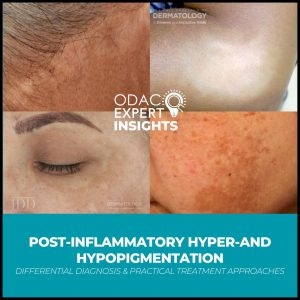
Post-Inflammatory Hyper-and Hypopigmentation: ODAC Highlights

By Medical Dermatology

post-inflammatory hyperpigmentation

Our sister conference, the ODAC Dermatology Conference, also offers sessions that address the dermatologic treatment of patients with skin of color. At ODAC 2025, Pooja Sodha, MD, associate professor of dermatology and director of laser and cosmetic dermatology at GWU School of Medicine and Health Sciences, presented a comprehensive, case-based review of post-inflammatory hyperpigmentation and post-inflammatory hypopigmentation. In the session, Dr. Sodha highlighted diagnostic techniques and a stepwise, multimodal treatment approach.

Post-Inflammatory Hyperpigmentation (PIH)

PIH results from inflammation-induced melanocyte activation, often triggered by trauma, medications, or autoimmune processes. Dr. Sodha emphasized differentiating PIH from mimickers, such as melasma and drug-induced pigmentation. Diagnosis relies on clinical history and visual examination, aided by Wood’s lamp, polarized photography, and reflectance confocal microscopy for depth assessment and histologic correlation.

Treatment strategies target both the inflammatory trigger and melanin production pathway, using:

  • Hydroquinone and mild topical steroids for short-term pigment inhibition.
  • Timolol gel to reduce early post-inflammatory erythema.
  • 2MNG with niacinamide to safely block melanosome transfer.
  • Laser modalities, such as 595-nm pulsed dye laser and 1927-nm diode laser, for vascular and epidermal pigment targets.
  • Topical antioxidants (silymarin, vitamin C, ferulic acid) and retinoids (tazarotene) to combat oxidative stress.
  • Laser-assisted drug delivery (LADD) with tranexamic acid to enhance pigment reduction.
  • Cysteamine cream as a long-term alternative to hydroquinone.
  • 1064-nm picosecond laser (Pico-toning) for dermal pigment shattering and remodeling.

Dr. Sodha underscored the vascular component of PIH, linking elevated VEGF levels to increased melanogenesis and advocating early treatment of erythema.

Post-Inflammatory Hypopigmentation (PIHpo)

PIHpo can arise after laser-induced injury, especially with excessive fluence or improper wavelength selection.

Management aims to restore melanocyte function using:

  • Topical clobetasol, transitioning to tacrolimus ointment for long-term use.
  • Bimatoprost to stimulate melanocyte migration and melanin synthesis.
  • 1550-nm erbium-doped fractional laser with LADD of bimatoprost for repigmentation.
  • Excimer laser therapy, offering up to 70% improvement, though requiring multiple sessions.

Key Takeaways

  • A deep understanding of inflammation’s impact on melanocytes is essential for both PIH and PIHpo.
  • Early intervention, combination therapy, and individualized treatment based on skin type and pigmentation depth yield the best outcomes.
  • Laser-assisted drug delivery enhances topical efficacy.
  • Patient education on treatment duration and session expectations is vital for success.

This session summary was written by Dr. Kala Hurst and published on Next Steps in Derm.

JDD Buzz: Dermatologic Hazards of Nail Products

By Medical Dermatology

hazards of nail products

Guiding patients in making sound decisions about the care of their skin, hair, and nails is foundational to quality dermatologic care. In recognition of National Healthy Skin Month, read this Next Steps in Derm commentary about the dermatologic hazards of nail products, both those used in the salon and at home. Emma Scott, BS, lead author of an October Journal of Drugs in Dermatology review on the topic, shares how the hazards of nail products go beyond UV light exposure and risks of a salon-acquired infection. Nail product usage can lead to allergic contact dermatitis, including dermatitis on other sites on the body due to hand transfer. In addition, using nail products can lead to nail damage and even paresthesia.

Learn what chemicals are involved in these allergic reactions and the impact of nail product usage on a person’s overall health. Find out the latest research in the risks of UV light exposure during gel manicures. (Do gel manicures increase a person’s skin cancer risk?) Plus hear the author’s take on how dermatologists should counsel their patients about the use of nail products, including practical steps patients can take to reduce their risks of adverse outcomes.