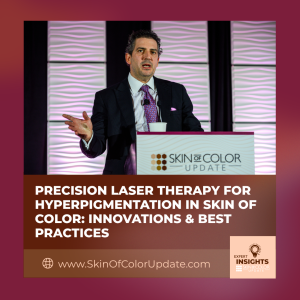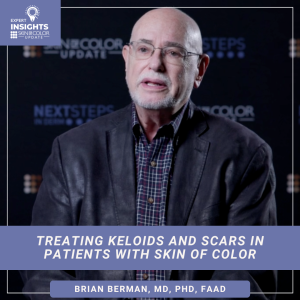
At Skin of Color Update 2025, Brian Berman, MD, PhD, FAAD, reviewed the burden of keloid scarring and highlighted emerging insights into keloid biology and treatment strategies. Dr. Berman noted that many treatments he discussed are used off-label, highlighting the lack of FDA-approved therapies despite the magnitude of disease impact. Importantly, recurrence remains a hallmark challenge: outcomes following excision alone demonstrate over 70% recurrence, underscoring the need for combination-based strategies rather than excision monotherapy.
Dr. Berman detailed one such strategy using postoperative superficial radiation therapy (SRT). In a retrospective review of 96 excised keloids treated with three fractions of 6 Gy delivered to the incision and a 5-mm margin on postoperative days 1–3, recurrence was reduced to 10.4% at 12 months, with an estimated 85.6% cure rate at 24 months and beyond. Clinical images demonstrated durable improvement in scar height and symptoms, reinforcing the real-world durability of SRT-based recurrence prevention. Topical imiquimod was presented as an alternative adjuvant option in select locations such as the ear, where relapse rates ranged from 15% at one year to 20% at five years when applied daily for eight weeks after shave removal and curettage.
Dr. Berman reviewed a recent network meta-analysis by Yang et al., demonstrating that botulinum toxin A (BTX-A) and TAC + 5-FU provide the strongest overall efficacy among intralesional keloid therapies, with bleomycin also performing favorably, while verapamil ranked among the least effective options. He highlighted a direct comparison trial in which BTX-A produced higher rates of >75% flattening (58.8% vs 31.4%) and markedly lower recurrence (8.8% vs 31.4%) than 5-FU, while also causing fewer pigmentary shifts, an important advantage in patients with skin of color who are prone to both hyper and hypopigmentation.
Dr. Berman described molecular advances that further support a movement toward targeted therapeutics. Transcriptomic analysis reveals that keloids are biologically distinct from hypertrophic scars, with overexpression of extracellular matrix genes such as COL10A1 and COL11A1 and keratin KRT6C, while other signaling pathways including BMP3 are downregulated. He noted that En1-negative fibroblasts convert into En1-positive scar-forming fibroblasts and ultimately account for 40–50% of all scar fibroblasts, and that selective ablation of these cells prevents scar formation in preclinical models. These data suggest that dysregulated fibroblast-driven matrix remodeling lies at the core of keloid behavior.
Mechanical tension was emphasized as a major contributor to aberrant scar biology. In a split-scar study, botulinum toxin A injected post-operatively reduced scar height and width and improved global appearance compared with control-treated halves, supporting the concept of tension-reduction as a modifiable driver of scar quality. Dr. Berman also presented a preoperative strategy using fractional 1540-nm Erbium glass laser applied 24 hours prior to planned surgery, which led to improved scar outcomes at 12 months per POSAS scoring. These findings collectively reinforce an evolving treatment philosophy that early intervention can be utilized to redirect wound-healing pathways before fibrosis is established.
Dr. Berman also highlighted early medical interventions aimed at preventing abnormal scarring, especially in patients with skin of color who are more prone to both dyschromia and hypertrophic scar responses. He presented clinical trial data evaluating trifarotene 0.005% cream for acne scar prevention, showing progressive and statistically significant improvement in Scar Global Assessment scores over 24 weeks. These findings underscore the importance of identifying patients with inflammatory acne who are at high risk of scarring and initiating therapy early, before permanent fibrosis and pigment alteration occur.
Looking ahead, Dr. Berman discussed several emerging modalities. He shared that isolated case reports (n=1-2) have shown improvement in keloid size or pain using standard dupilumab dosing regimens (600 mg loading followed by 300 mg every two weeks), whereas small case series including up to eight patients have demonstrated minimal benefit overall, and in some instances worsening or enlargement of lesions. Ongoing clinical trials will be necessary to better define its role. He also highlighted groundbreaking regenerative research demonstrating that post-natal wounds form scars when YAP-dependent mechanotransduction drives En1-positive fibroblast activation. Inhibiting this pathway (i.e with verteporfin) has enabled scar-free healing with re-formation of adnexal structures, representing a potential future paradigm shift toward true regenerative, rather than simply anti-fibrotic therapy.
Dr. Berman also highlighted novel targeted approaches still in very early development, including diphtheria toxin–based fibroblast ablation strategies designed to selectively eliminate pathological keloid fibroblasts while minimizing collateral damage to surrounding tissue. While these concepts remain in preclinical phases, they further illustrate the expanding therapeutic landscape aimed at directly modifying keloid biology rather than simply suppressing its clinical manifestations.
Dr. Berman concluded by reinforcing a central principle: patients with skin of color are uniquely vulnerable to both keloid formation and treatment-related sequelae. A thoughtful, multimodal, and mechanistically informed approach is required to reduce recurrence, protect pigmentation, and improve long-term cosmetic and symptomatic outcomes.
Take-Home Points:
- Excision alone has high recurrence (>70%); combination approaches are essential in skin of color.
- Surgical tension reduction and immediate postoperative adjuvant therapy, particularly SRT, significantly improve outcomes.
- TAC + 5-FU and botulinum toxin A represent the most effective and pigment-safe intralesional approaches reviewed.
- Early medical and procedural intervention, including acne scar prevention strategies, plays a critical role in reducing long-term fibrosis and pigmentary sequelae in patients with skin of color.
- Molecular studies confirm keloids are biologically distinct scars, guiding development of targeted and regenerative future treatments.
This information was presented at the 2025 Skin of Color Update conference by Brian Berman, MD, PhD, FAAD. The above highlights from this lecture were written and compiled by Courtney Hanna, MD, MPH.
References:
Berman, B., Nestor, M. S., Gold, M. H., Goldberg, D. J., Weiss, E. T., & Raymond, I. (2020). A retrospective registry study evaluating the long-term efficacy and safety of superficial radiation therapy following excision of keloid scars. The Journal of Clinical and Aesthetic Dermatology, 13(10), 12.
Dréno, B., Bissonnette, R., Gagné-Henley, A., Barankin, B., Lynde, C., Kerrouche, N., & Tan, J. (2018). Prevention and Reduction of Atrophic Acne Scars with Adapalene 0.3%/Benzoyl Peroxide 2.5% Gel in Subjects with Moderate or Severe Facial Acne: Results of a 6-Month Randomized, Vehicle-Controlled Trial Using Intra-Individual Comparison. American journal of clinical dermatology, 19(2), 275–286. https://doi.org/10.1007/s40257-018-0352-y
Frias, J., Vargas, R., Paez, E., Chopite, M., Reyes, O., Soucre, N., … & Berman, B. (2018). Effects of Imiquimod 5% Cream in the Prevention of Excised Keloid Recurrence. SKIN The Journal of Cutaneous Medicine, 2(1), 44-46.
Friedman, O., Gofstein, D., Arad, E., Gur, E., Sprecher, E., & Artzi, O. (2020). Laser pretreatment for the attenuation of planned surgical scars: a randomized self-controlled hemi-scar pilot study. Journal of Plastic, Reconstructive & Aesthetic Surgery, 73(5), 893-898.
Hu, L., Zou, Y., Chang, S. J., Qiu, Y., Chen, H., Gang, M., … & Lin, X. (2018). Effects of botulinum toxin on improving facial surgical scars: a prospective, split-scar, double-blind, randomized controlled trial. Plastic and reconstructive surgery, 141(3), 646-650.
Lawrence W. T. (1991). In search of the optimal treatment of keloids: report of a series and a review of the literature. Annals of plastic surgery, 27(2), 164–178. https://doi.org/10.1097/00000637-199108000-00012
Mascharak, S., desJardins-Park, H. E., Davitt, M. F., Griffin, M., Borrelli, M. R., Moore, A. L., Chen, K., Duoto, B., Chinta, M., Foster, D. S., Shen, A. H., Januszyk, M., Kwon, S. H., Wernig, G., Wan, D. C., Lorenz, H. P., Gurtner, G. C., & Longaker, M. T. (2021). Preventing Engrailed-1 activation in fibroblasts yields wound regeneration without scarring. Science (New York, N.Y.), 372(6540), eaba2374. https://doi.org/10.1126/science.aba2374
Shaffer, J. J., Taylor, S. C., & Cook-Bolden, F. (2002). Keloidal scars: a review with a critical look at therapeutic options. Journal of the American Academy of Dermatology, 46(2 Suppl Understanding), S63–S97. https://doi.org/10.1067/mjd.2002.120788
Shmieder MS, Armenta AM, et al. Surgical excision of keloids followed by in-office superficial radiation therapy (SRT-100) using a customized dosing protocol: A retrospective study. Wounds. 2019;31(5):123-128
Walter, A. S., Stocks, M., Akova, E., Gauglitz, G., Hartmann, D., Aszodi, A., Böcker, W., Saller, M. M., & Volkmer, E. (2023). Keloids are transcriptionally distinct from normal and hypertrophic scars. European journal of dermatology : EJD, 33(6), 604–611. https://doi.org/10.1684/ejd.2023.4582
Yang, H. A., Jheng, W. L., Yu, J., Huang, J. Y., Cheng, K. Y., & Lee, J. J. (2024). Comparative Efficacy of Drug Interventions for Keloids: A Network Meta-analysis. Annals of plastic surgery, 92(1S Suppl 1), S52–S59. https://doi.org/10.1097/SAP.0000000000003759
Zeichner, J. A., Eichenfield, L. F., Blume-Peytavi, U., Dréno, B., Alexis, A. F., Stein Gold, L. F., Bélanger, A., Duteil, L., & Sankhala, K. (2024). Efficacy and safety of trifarotene 50 μg/g cream for prevention of atrophic acne scars: A randomized, vehicle-controlled trial. Drugs in Context, 13, 1–11. https://doi.org/10.7573/dic.2023-8-6