Monthly Archives

March 2026

Traction Alopecia in Children: SOCU Video Interview

By Sessions

traction alopecia

Traction alopecia is a common subtype of alopecia in children and one that requires culturally sensitive care, according to Brandi Kenner-Bell, MD, FAAD. In this Next Steps in Derm video interview from Skin of Color Update, Dr. Kenner-Bell says clinicians should first understand a child’s haircare practices and cultural styling preferences before offering recommendations.

In the video, Dr. Kenner-Bell shares ways for dermatology clinicians to work collaboratively with children and their parents to protect hair health while respecting cultural practices. She shares tips she’s learned in her own practice at the Ann and Robert H. Lurie Children’s Hospital of Chicago, including questions to ask at a traction alopecia office visit.

Improving Vitiligo Outcomes for Patients With Skin of Color

By Uncategorized

vitiligo in patients with skin of color

Vitiligo in patients with skin of color is especially burdensome due to the stark contrast between pigmented and nonpigmented skin. Thankfully, recent breakthroughs can halt disease progression as well as repigment the skin. In this Next Steps in Derm interview from Skin of Color Update, Pearl E. Grimes, MD, FAAD, a noted vitiligo expert, shares the results of available therapies for vitiligo in patients with skin of color.

Dr. Grimes is founder and chair of the upcoming Pigmentary Disorders Exchange Symposium to be held June 6 and 7 in Chicago. The conference will provide an in-depth exploration of skin pigmentation, including pigmentary sequelae that follow inflammatory skin conditions. In addition, the expert faculty will cover pathogenesis, clinical presentation, and cutting-edge treatment strategies for primary pigmentation conditions, such as vitiligo, as well as congenital presentations, and acquired dermal macular hyperpigmentation, across the full spectrum of skin types. Register today!

Diet and HS: JDD Buzz

By Medical Dermatology

Diet and HS

A review in the Journal of Drugs in Dermatology highlights diet as a promising adjunct in hidradenitis suppurativa (HS) management, with emerging evidence that targeted dietary changes may reduce inflammation and disease severity.

In this interview with Next Steps in Derm, the study’s authors outline the main takeaway: Several dietary strategies may benefit some patients. Avoiding dairy and brewer’s yeast has been associated with symptom improvement, likely by reducing hormonal and immune triggers linked to follicular plugging and inflammation. Diets that lower systemic inflammation—such as the Mediterranean diet and very-low-calorie ketogenic diet—have shown encouraging results in small studies. Limiting leucine-rich foods (e.g., meat, eggs, and dairy) may also help by reducing mTOR-driven pathways involved in HS lesion formation.

Addressing micronutrient deficiencies is another low-risk strategy. Supplementation with vitamin D or zinc in deficient patients has produced clinical improvement in some cases. In addition, intermittent fasting, including Ramadan-style fasting, has been associated with reduced inflammatory markers and lesion severity in a subset of patients.

Although most studies are small and further research is needed, the findings support diet as a personalized, noninvasive adjunct to medical therapy. Clinicians should move beyond general advice and consider discussing specific dietary patterns—such as Mediterranean, dairy-free, or brewer’s yeast–free approaches—with patients seeking to optimize HS control or reduce reliance on systemic medications.

JAK Inhibitor Responses by Race: SOCU in the News

By Media Coverage

JAK inhibitor responses

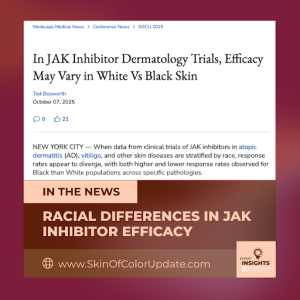
An analysis presented at the 2025 Skin of Color Update explores whether JAK inhibitor responses differ by race in dermatologic diseases, such as atopic dermatitis (AD), vitiligo, and alopecia areata. Brett King, MD, PhD, examined outcomes by race and, when available, Fitzpatrick skin type (FST). Although no statistical testing was performed, numerical differences in response rates were observed, warranting further study.

Medscape’s news coverage of the session details phase 3 trial data for approved JAK inhibitors. In AD trials of abrocitinib, Black patients (8.8% of participants) had lower week 12 IGA 0/1 response rates compared with White patients (28% vs 43% at the 200 mg dose). Similar gaps were seen in pruritus reduction. In upadacitinib trials, Black patients showed nearly a 20% lower EASI-90 response than White patients at the 15 mg dose (24.1% vs 43.3%), though this difference diminished at 30 mg. Trials of ruxolitinib cream for AD also showed lower IGA 0/1 responses among Black patients compared with White and Asian patients.

However, this pattern did not hold in vitiligo trials of ruxolitinib cream, where Black patients had equal or higher response rates than other groups. Greater improvement was also observed in patients with darker Fitzpatrick skin types in some analyses. These findings raise questions about whether differences reflect biological variation, dosing, disease assessment challenges (such as recognizing erythema in darker skin), or even diagnostic inaccuracies, as highlighted by a reanalysis of alopecia areata trial photographs that identified misclassification in several Black patients.

Importantly, serious adverse events were rare across racial groups, and safety concerns associated with JAK inhibitors in rheumatoid arthritis trials have not appeared to translate to dermatologic populations.

Both Dr. King and Skin of Color Update Co-Chair Andrew F. Alexis, MD, MPH, FAAD, emphasized that these findings on JAK inhibitor responses are preliminary and hypothesis-generating. Larger, more diverse trials—particularly those stratified by skin type—are needed to determine whether true differences in treatment response exist and to improve disease assessment across diverse patient populations.