
Monthly Archives

May 2026

Pigmentary Impact of Acne: SOCU Video Interview

By Sessions

pigmentary impact of acne

“Our patients hate these marks. They hate them more than they hated their acne to begin with.”  — Hilary Baldwin, MD, FAAD

Don’t miss this insightful interview on the pigmentary impact of acne, conducted by Next Steps in Derm in partnership with Skin of Color Update. Dr. Baldwin reviews how her management of acne and post‑inflammatory pigmentary changes has evolved. She shares practical, clinic-ready guidance including:

  • Whether to take an acne‑first approach or treat acne and hyperpigmentation simultaneously
  • Why “scars” is often the wrong term for certain post‑acne pigmentary changes
  • How she safely incorporates new over‑the‑counter topicals into patients’ routines to address pigmentary alteration

If you treat acne in patients with skin of color (or anyone troubled by persistent pigmentation), join us in Chicago June 6 and 7 for the Pigmentary Disorders Exchange Symposium. Sessions will address the pigmentary sequelae of inflammatory skin conditions, including acne and atopic dermatitis, as well as the latest in the management of pigmentary conditions, including melasma and vitiligo.

Scalp Biopsies for CCCA: JDD Buzz

By Uncategorized

scalp biopsies for CCCA

A recent Journal of Drugs in Dermatology brief communication and interview with Temitayo A. Ogunleye, MD, explore why patients often decline scalp biopsy despite its role in securing a diagnosis that can enable hair‑saving treatment. Key insights: Patients who consented demonstrated clearer understanding and greater trust in their clinicians; those who declined frequently had knowledge gaps rather than firm opposition, and many remained open to biopsy if their condition progressed.

Practical takeaways:

  • Introduce biopsy early and link it to outcomes patients value
  • Use clear, patient‑centered explanations about risks, benefits, and how biopsy may change management
  • Proactively address common concerns and build trust
  • Revisit the conversation over time—many patients will reconsider as the disease evolves

For dermatologists treating CCCA in skin of color, prioritizing education and shared decision‑making can improve diagnostic yield and treatment outcomes.

Unique Skin Conditions in Asian Patients: SOCU Session Summary

By Sessions

Asian skin dermatology

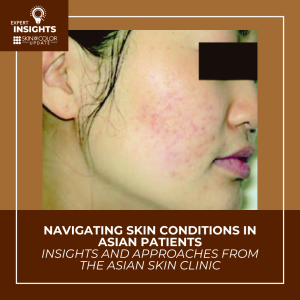
Here’s a summary of key clinical pearls from the Skin of Color Update lecture by Hye Jin (Leah) Chung, MD, MMSc, FAAD, on managing dermatologic conditions in Asian patients:

  • Asian skin: higher ceramide content but greater propensity for reactivity → prioritize efficacy while minimizing irritation and PIH.
  • Melasma: emphasize photoprotection (tinted sunscreens to block visible/blue light) and gentler topicals (azelaic acid, kojic acid, topical TXA) over irritant triple combinations or cysteamine.
  • Oral tranexamic acid (TXA): Dr. Chung’s protocol — 325 mg BID × 3 months, then 325 mg daily × 3 months, then 6‑month drug holiday. Obtain thorough history and baseline thrombophilia testing (protein C/S, factor V Leiden, lupus anticoagulant, anticardiolipin antibodies) before initiation.
  • Lasers and pigment: low‑fluence Q‑switched or picosecond Nd:YAG for subcellular photothermolysis; consider picosecond/Q‑switched for deep dermal pigment (ABNOM). 1927 nm can help PIH via controlled epidermal/papillary dermal coagulation.
  • Scars: CROSS with TCA for ice‑pick scars; consider ablative CO₂ for papular scars (or needle + electrosurgery where laser unavailable).
  • Device safety: favor microneedling, fractional RF microneedling, and fractional picosecond modalities; use high‑energy/low‑density settings if performing fractional ablative/nonablative treatments to reduce PIH risk.

The write-up was written by Jay Nguyen, DO, and posted to Next Steps in Derm.

Atopic Dermatitis in Skin of Color: SOCU Video Interview

By Sessions

atopic dermatitis in skin of color

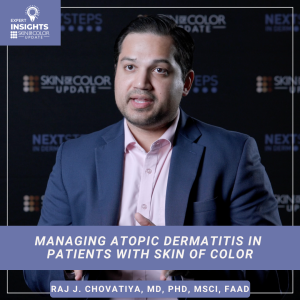
Next Steps in Derm, in partnership with Skin of Color Update, sat down with Raj J. Chovatiya, MD, PhD (associate professor, Rosalind Franklin University/Chicago Medical School), to discuss diagnosing and treating atopic dermatitis in patients with darker skin tones.

Watch to learn:

  • Practical tips Dr. Chovatiya shares with trainees for recognizing AD in skin of color
  • How differences in presentation can influence treatment choice
  • His patient-centered approach (“Patients aren’t textbooks!”)
  • How to interpret the latest AD research for clinical care

Whether you teach, consult, or see a diverse clinic population, this conversation will sharpen diagnostic skills and therapeutic decision‑making.