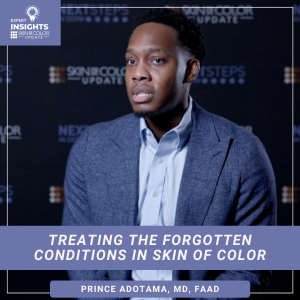
At the 2025 Skin of Color Update, Prince Adotama, MD, FAAD, started his lecture with a discussion on acne keloidalis nuchae (AKN), a chronic inflammatory condition that leads to fibrotic papules, plaques and potentially keloidal nodules and plaques. This occurs most commonly in African Americans with a reported prevalence up to 13.6%. The pathogenesis of AKN is poorly understood but is thought to be initiated by a mechanically induced folliculitis that becomes extensive enough to result in scar formation. Similarly to pseudofolliculitis barbae (PFB), trauma and mechanical irritation could lead to a primary cicatricial alopecia.
Dr. Adotama also highlighted the role of metabolic syndrome in patients with AKN, citing multiple studies demonstrating a strong association between AKN and metabolic syndrome. It is important that physicians are aware of this possible comorbidity, and similar studies have shown increased risk of hypertension and hypothyroidism in patients with AKN.
Treatment for AKN includes topical and/or oral antimicrobials/antibiotics, as well as topical retinoids, topical steroids, and steroid injections. Laser hair removal (LHR) using diode and Nd:YAG and Alexandrite lasers can be helpful in the early papular stages. Surgical excision is recommended for keloidal plaques that are greater than 3 cm.
Additionally, unlike PFB, patients with AKN can utilize higher potency topical steroids. Dr. Adotama discussed that two weeks on and two weeks off for 8 weeks of topical clobetasol can be used, followed by betamethasone valerate for 4 weeks. This regimen did not yield any side effects of skin atrophy and showed a significant decrease in symptoms at 12 weeks. For patients that can tolerate intralesional steroids, using a strength as high as 40 mg/mL can be used in some cases if there is a keloidal component.
Dr. Adotama focused on an improved injection technique for AKN, where the clinician takes 5-10 mg/mL of triamcinolone and injects 0.1 mL aliquots into the deep dermis in 1 cm intervals until the entire area of involvement is completely treated (in contrast to injecting each individual lesion). This technique was published in the Journal of Dermatologic Surgery in July 2023, where Dr. Adotama presented a case of a 24-year-old man with Fitzpatrick skin type VI who had a six-year history of AKN. The patient had no prior treatments and after one round of deep dermal injections with triamcinolone 5 mg/mL (total volume of 1.4 mL) with topical clindamycin, the patient demonstrated significant improvement.
Dr. Adotama also reviewed the use of topical diclofenac sodium gel in the treatment of both AKN and dissecting cellulitis of the scalp (DCS). Although the mechanism of diclofenac sodium gel for either of these conditions is not fully described, the authors hypothesized that the diclofenac-related effects might result in an overall decrease in the neutrophilic and mixed-lymphocytic infiltrate in hair follicles of patients with DCS and AKN. Four patients were followed (3 with DCS and 1 with AKN) in this study. All 3 patients with DCS showed substantial improvement with diclofenac gel monotherapy, with most lesions resolving within a 3-month treatment period. A similar response was observed in the patient with AKN after 1-month of therapy.
For patients with a papular component, use of the long-pulsed Nd:YAG laser in conjunction with topical steroids has shown promising results in the treatment of AKN. Dr. Adotama highlighted a decrease in global assessment score on the treated side as compared to the control side, which although not statistically significant, did show clinical improvement. In a sub analysis that excluded patients with nodules and plaques, there was a statistically significant change between the treatment and control side, highlighting the importance of early treatment at the papular stage.
In patients who have more extensive disease, AKN lesions can be removed via a horizontal ellipse that includes the posterior hairline. Dr. Adotama highlighted the importance of this technique, as two of the six patients had a nonelliptic excision of the posterior aspect of the scalp that spared the posterior hairline and resulted in an inferior cosmetic outcome. A review from 2025 of surgical complications from AKN removal highlighted the low rate of complications, with an approximate 19% incidence of AKN recurrence after excision, an 11% incidence of hypertrophic scarring, and 3% incidence of infection.
Overall, Dr. Adotama provided three main topical treatment recommendations for patients with AKN:
- Retinoid: Vary strength depending on skin sensitivity and hyperpigmentation
- Steroid: Choose a mid-high potency
- Antimicrobial or antibiotic: Typically, benzoyl peroxide or clindamycin combination, although patients may require an oral antibiotic
In addition to topical treatments, injections are often necessary and Dr. Adotama recommended using the deep dermis technique with 5-10 mg/mL concentration for the papular variant.
Dissecting Cellulitis (DCS)
DCS is a neutrophilic alopecia with IL-1 playing an important role. Hidradenitis suppurativa (HS) is a comorbidity given its shared pathway, and one study found that more than half of patients with DCS presented with comorbidities related to follicular occlusion tetrad, with HS being the most frequent. Dr. Adotama also highlighted his study on long-term cardiovascular morbidity in DCS and found that DCS is associated with elevated risk of thrombotic and ischemic events similar to those reported in HS and moderate-to-severe psoriasis.
DCS most commonly presents in the second to third decade of life in African American men. It progresses through stages with the first stage marked by isolated nodules/abscesses and separated by normal skin without intercommunicating sinus tracts or scarring alopecia. As the disease progresses from stage II to III, it begins to demonstrate nodules and abscesses with intercommunicating sinus tracts, with the hallmark of stage III being scarring or permanent alopecia.
Treatment Options for Dissecting Cellulitis
Isotretinoin can be considered in refractory cases to topical therapy. Second-line therapy includes biologics, with TNF-alpha inhibitors having the highest efficacy (87% of patients demonstrated a sustained improvement). Additionally, dapsone can be used for stage II or III disease with or without isotretinoin. Surgery is also an option for patients and can be curative with 95% of patients in one study demonstrating sustained improvement.
Dr. Adotama discussed updated cases of patients who were trialed on a variety of biologics with improvement in DCS. One patient, a 26-year-old male with DCS, experienced significant clinical improvement following a short course of upadacitinib. The patient had tried and failed multiple other treatment modalities, however, following the initiation of upadacitinib, the patient had reduced pain and significant improvement in his quality of life. Apremilast was also utilized in a patient who had been recalcitrant to topical and systemic therapy (including isotretinoin, minocycline, Bactrim, and adalimumab). After 6 months of 30 mg twice-daily apremilast, the patient reported dramatic improvement in disease symptoms and reduction in flares with no notable side effects.
Dr. Adotama concluded his presentation with information on the Scarring Alopecia Foundation, a nonprofit organization dedicated to raising awareness, supporting research, and providing education about cicatricial (scarring) alopecias. Its mission includes offering resources to patients, connecting them with specialists, and funding scientific studies aimed at understanding and treating scarring hair loss disorders.
This summary was prepared by Dr. Courtney Hanna, dermatology resident, who attended the session. The content reflects the resident’s notes and interpretations, may contain errors, and is provided for educational purposes only. It does not constitute official faculty endorsement and should not replace original sources or clinical judgment.
References:
Adotama, P., Grullon, K., Ali, S., & Okoye, G. A. (2023). How we do it: our method for triamcinolone injections of acne keloidalis nuchae. Dermatologic Surgery, 49(7), 713-714.
Alexis, A., Heath, C. R., & Halder, R. M. (2014). Folliculitis keloidalis nuchae and pseudofolliculitis barbae: are prevention and effective treatment within reach?. Dermatologic clinics, 32(2), 183-191.
Badaoui, A., Reygagne, P., Cavelier‐Balloy, B., Pinquier, L., Deschamps, L., Crickx, B., & Descamps, V. (2016). Dissecting cellulitis of the scalp: a retrospective study of 51 patients and review of literature. British Journal of Dermatology, 174(2), 421-423.
Bernard, J. W., Reddy, S., & Flowers, R. H. (2023). The successful use of oral apremilast for a case of dissecting cellulitis. JAAD Case Reports, 39, 122-124.
Callender, V. D., Young, C. M., Haverstock, C. L., Carroll, C. L., & Feldman, S. R. (2005). An open label study of clobetasol propionate 0.05% and betamethasone valerate 0.12% foams in the treatment of mild to moderate acne keloidalis. Cutis, 75(6), 317-321.
Gamissans, M., Romaní, J., López‐Llunell, C., Riera‐Martí, N., & Sin, M. (2022). Dissecting cellulitis of the scalp: A review on clinical characteristics and management options in a series of 14 patients. Dermatologic Therapy, 35(8).
Hinson, C., Sink, M., Odobescu, A., Sammer, D. M., & Zhang, A. Y. (2025). Surgical management of acne keloidalis nuchae: A systematic review of outcomes and techniques. Journal of Plastic, Reconstructive & Aesthetic Surgery, 104, 102-112.
Islam, Z., Toker, M., Gandhi, I. M., Sher, A., Campton, K., & Gandhi, I. (2024). Improvement of recalcitrant dissecting cellulitis of the scalp after a trial of upadacitinib. Cureus, 16(1).
Kridin, K., Solomon, A., Tzur-Bitan, D., Damiani, G., Comaneshter, D., & Cohen, A. D. (2020). Acne keloidalis nuchae and the metabolic syndrome: a population-based study. American Journal of Clinical Dermatology, 21(5), 733-739.
Lee, C. N., Chen, W., Hsu, C. K., Weng, T. T., Lee, J. Y. Y., & Yang, C. C. (2018). Dissecting folliculitis (dissecting cellulitis) of the scalp: a 66‐patient case series and proposal of classification. JDDG: Journal der Deutschen Dermatologischen Gesellschaft, 16(10), 1219-1226.
Maranda, E. L., Simmons, B. J., Nguyen, A. H., Lim, V. M., & Keri, J. E. (2016). Treatment of acne keloidalis nuchae: a systematic review of the literature. Dermatology and therapy, 6(3), 363-378.
Melo, D. F., Ramos, P. M., Machado, C. J., Anzai, A., Blanco, A., Mulinari-Brenner, F., … & Doche, I. (2022). Dissecting cellulitis in women: a retrospective multicenter study with 17 patients. International journal of dermatology, 61(11), e427-e430.
Michelen-Gómez, E. A., Chiesa Fuxench, Z. C., Cancel-Artau, K. J., Guerrero, A., Ibrahim, O., Santaliz-Ruiz, L. E., 4th, & Colon-Fontanez, F. (2023). Treatment of acne keloidalis nuchae and dissecting cellulitis of the scalp with diclofenac sodium gel: a case series. JAAD case reports, 42, 113–116. https://doi.org/10.1016/j.jdcr.2023.09.008
Ogunbiyi, A. (2016). Acne keloidalis nuchae: prevalence, impact, and management challenges. Clinical, Cosmetic and Investigational Dermatology, 483-489.
Patel, D., Thakker, S., Olagun-Samuel, C., Wang, D., Mitchell, J., & Adotama, P. (2025). Long-term cardiovascular morbidity in dissecting cellulitis: A propensity-matched TrinetX cohort study. Journal of the American Academy of Dermatology, 93(6), 1614-1616.
Saka, B., Teclessou, J. N., Akakpo, S. A., Pessinaba, S., Gnossike, P., Mahamadou, G., … & Pitché, P. (2020). Acne keloidalis nuchae and hypertension in black subjects: a case–control study. BMC Research Notes, 13(1), 431.
Shah, G. K. (2005). Efficacy of diode laser for treating acne keloidalis nuchae. Indian Journal of Dermatology, Venereology, and Leprology, 71(1), 31.
Sperling, L. C., Homoky, C., Pratt, L., & Sau, P. (2000). Acne keloidalis is a form of primary scarring alopecia. Archives of dermatology, 136(4), 479-484.
Thomas, J., & Aguh, C. (2021). Approach to treatment of refractory dissecting cellulitis of the scalp: a systematic review. Journal of Dermatological Treatment, 32(2), 144-149.
Valdman-Grinshpoun, Y., Kridin, K., Schonmann, Y., & Cohen, A. D. (2021). Acne keloidalis nuchae and thyroid diseases: a population-based cohort study. International journal of dermatology, 60(4), 466–470. https://doi.org/10.1111/ijd.15331