
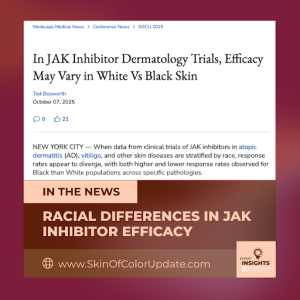
An analysis presented at the 2025 Skin of Color Update explores whether JAK inhibitor responses differ by race in dermatologic diseases, such as atopic dermatitis (AD), vitiligo, and alopecia areata. Brett King, MD, PhD, examined outcomes by race and, when available, Fitzpatrick skin type (FST). Although no statistical testing was performed, numerical differences in response rates were observed, warranting further study.
Medscape’s news coverage of the session details phase 3 trial data for approved JAK inhibitors. In AD trials of abrocitinib, Black patients (8.8% of participants) had lower week 12 IGA 0/1 response rates compared with White patients (28% vs 43% at the 200 mg dose). Similar gaps were seen in pruritus reduction. In upadacitinib trials, Black patients showed nearly a 20% lower EASI-90 response than White patients at the 15 mg dose (24.1% vs 43.3%), though this difference diminished at 30 mg. Trials of ruxolitinib cream for AD also showed lower IGA 0/1 responses among Black patients compared with White and Asian patients.
However, this pattern did not hold in vitiligo trials of ruxolitinib cream, where Black patients had equal or higher response rates than other groups. Greater improvement was also observed in patients with darker Fitzpatrick skin types in some analyses. These findings raise questions about whether differences reflect biological variation, dosing, disease assessment challenges (such as recognizing erythema in darker skin), or even diagnostic inaccuracies, as highlighted by a reanalysis of alopecia areata trial photographs that identified misclassification in several Black patients.
Importantly, serious adverse events were rare across racial groups, and safety concerns associated with JAK inhibitors in rheumatoid arthritis trials have not appeared to translate to dermatologic populations.
Both Dr. King and Skin of Color Update Co-Chair Andrew F. Alexis, MD, MPH, FAAD, emphasized that these findings on JAK inhibitor responses are preliminary and hypothesis-generating. Larger, more diverse trials—particularly those stratified by skin type—are needed to determine whether true differences in treatment response exist and to improve disease assessment across diverse patient populations.
