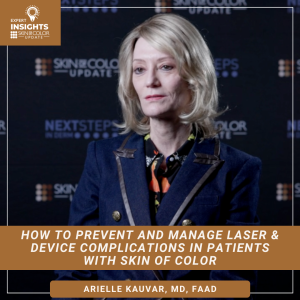
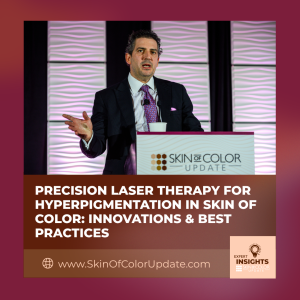
Hyperpigmentation, including melasma, lentigines, post-inflammatory hyperpigmentation (PIH), and congenital and acquired dermal melanocytosis, remains one of the most common and challenging concerns in skin of color. Laser-based approaches must be carefully calibrated to avoid complications such as worsening pigmentation or scarring. At Skin of Color Update 2025, Paul M. Friedman, MD, FAAD, reviewed precision-based laser strategies tailored to pigmentary disorders in diverse skin types, focusing on device selection, wavelength targeting, and combination therapy.
Laser and Light Technology for Pigmented Lesions
Q-Switched (QS) Lasers
Selective photothermolysis with nanosecond pulses targeting melanin:
| Wavelength | Device | Best suited for |
| 532 nm | Frequency-doubled Nd:YAG | Epidermal pigment (lentigines, ephelides, CALMs) |
| 694 nm | Ruby | Epidermal/dermal pigment |
| 755 nm | Alexandrite | Epidermal/dermal lesions |
| 1064 nm | Nd:YAG | Dermal pigment (i.e Nevus of Ota) |
These allow depth-based targeting according to wavelength penetration.
Picosecond Lasers
- High-peak power ultrashort pulses → enhanced pigment fragmentation
- Reduced epidermal injury → improved safety in darker skin
- Targets melasma, PIH, lentigines, café-au-lait macules, Nevus of Ota, tattoo pigment, hemosiderin staining
Fractional picosecond delivery
• Faster healing
• Collagen remodeling (scar co-benefit)
Fractional Photothermolysis
Non-ablative fractional resurfacing (NAFR) creates vertical columns of controlled dermal microinjury creating microscopic treatment zones (MTZs), leaving surrounding tissue intact to promote repair and pathways for melanin clearance.
Benefits:
• Dermal remodeling with lower PIH risk
• Assists in pigment removal when combined with pigment specific modalities resulting in transepidermal elimination of pigment.
Clinical Applications
Café-au-lait Macules (CALMs)
CALM with jagged or ill-defined borders, such as the coast of Maine subtype tend to respond well to laser treatment, whereas those with smooth and well-defined borders of the coast of California subtype tend to have poor response.
- Demonstrated success with 730-nm picosecond laser (serial treatment)
- 1550-nm non-ablative fractional options provide viability in darker skin
Melasma
Melasma is a chronic and relapsing pigmentary condition that requires a cautious and multimodal approach, particularly in skin of color due to the high risk of post-laser rebound hyperpigmentation. Strict sun and visible light photoprotection with iron oxide–containing sunscreen is foundational and should continue throughout treatment. Topical therapy (e.g., tranexamic acid, hydroquinone, retinoids, and other pigment-modulating agents) remains essential and laser intervention should only be considered when disease is stable.
UV photography can identify subclinical extension and help guide treatment planning and expectations.
Low-fluence, low-density laser approaches may be used to target dermal melanosis while minimizing thermal injury. Dr. Friedman emphasized the following devices as supported treatment strategies:
• 755-nm picosecond Alexandrite
• 1064-nm picosecond Nd:YAG
• 1927-nm fractional diode laser
Melasma frequently demonstrates a vascular component, contributing to persistent inflammation and dyspigmentation. When mild erythema or telangiectasia is present, 595-nm pulsed dye laser (PDL) may be cautiously incorporated as part of a phased treatment strategy.
Overall, the treatment goal is gradual improvement in dyschromia without triggering inflammatory flare or worsened PIH. Overly aggressive treatment parameters or too-frequent sessions increase this risk; therefore, conservative protocols with staged treatments and uninterrupted photoprotection are critical.
Post-Inflammatory Hyperpigmentation (PIH)
- Principles align with melasma
- Avoid aggressive thermal injury
- Device choice depends on depth of pigmentation
Nevus of Ota
- Blue-gray discoloration in V1/V2 distribution due to dermal melanocytes
- Requires ocular protection during laser therapy
- Best results with early, serial 1064-nm QS Nd:YAG
- Multimodal picosecond + fractional strategies enhance outcomes
- 785-nm picosecond titanium-sapphire effective for brown variants
Becker’s Nevus
Challenges: dual pigment + hypertrichosis
Combination approach improves clearance:
• Non-ablative fractional resurfacing (“melanin shuttle”) +
• Laser hair removal targeting follicular pigment
Photoaging
Evaluation of 2,910-nm erbium-doped fluoride glass fiber laser for Fitzpatrick IV photoaging is ongoing.
Advances in 3D Precision Targeting
New delivery systems allow:
• High-energy dermal deposition
• Minimal epidermal interaction
• Lower PIH risk in darker phototypes
These innovations improve the safety profile of pigment targeting in skin of color
Take-Home Points
- Picosecond platforms improve pigment fragmentation with enhanced epidermal sparing, increasing safety in darker skin tones.
- Melasma requires combination therapy and cautious laser use to avoid rebound hyperpigmentation.
- Non-ablative fractional lasers support pigment egress and synergize with pigment-selective lasers.
- Nevus of Ota responds best to multimodal wavelength strategies and early serial treatment.
- Device choice, low-fluence approaches, proper intervals, and strict photoprotection are essential to prevent PIH.
This information was presented at the 2025 Skin of Color Update conference Paul M. Friedman, MD, FAAD. The above highlights from this lecture were written and compiled by Courtney Hanna, MD, MPH.
References
Balaraman, B., & Friedman, P. M. (2016). Hypertrichotic Becker’s nevi treated with combination 1,550 nm non‐ablative fractional photothermolysis and laser hair removal. Lasers in Surgery and Medicine, 48(4), 350-353.
Belkin, D. A., Neckman, J. P., Jeon, H., Friedman, P., & Geronemus, R. G. (2017). Response to Laser Treatment of Café au Lait Macules Based on Morphologic Features. JAMA dermatology, 153(11), 1158–1161. https://doi.org/10.1001/jamadermatol.2017.2807
Bernstein, E. F., Schomacker, K. T., Basilavecchio, L. D., Plugis, J. M., & Bhawalkar, J. D. (2017). Treatment of acne scarring with a novel fractionated, dual‐wavelength, picosecond‐domain laser incorporating a novel holographic beam‐splitter. Lasers in surgery and medicine, 49(9), 796-802.
Fernandez, J. K., Guo, E. L., Richmond, H., & Friedman, P. M. (2024). The 730 nm picosecond titanium sapphire laser for treatment of café‐au‐lait macules in all skin types. Lasers in Surgery and Medicine, 56(3), 257-262.
Hantash, B. M., Bedi, V. P., Sudireddy, V., Struck, S. K., Herron, G. S., & Chan, K. F. (2006). Laser-induced transepidermal elimination of dermal content by fractional photothermolysis. Journal of biomedical optics, 11(4), 041115-041115.
Kubicki, S. L., Guo, E. L., Richmond, H., & Friedman, P. M. (2023). Treatment of Nevus of Ota in Black patients with the 1064 nm QS or picosecond laser and nonablative fractional photothermolysis. Lasers in Surgery and Medicine, 55(1), 67-72.
Kubicki, S. L., Guo, E. L., Sodha, P., Richmond, H., & Friedman, P. M. (2023). Combination 1550 nm non‐ablative fractional resurfacing and laser hair removal for treatment of Becker’s nevi in skin types III–VI. Lasers in surgery and medicine, 55(1), 99-104.
Manstein, D., Herron, G. S., Sink, R. K., Tanner, H., & Anderson, R. R. (2004). Fractional photothermolysis: a new concept for cutaneous remodeling using microscopic patterns of thermal injury. Lasers in Surgery and Medicine: The Official Journal of the American Society for Laser Medicine and Surgery, 34(5), 426-438.
Murray, Taryn N. MD*; Dick, Mary MD†; Friedman, Paul M. MD†,‡,§. A Novel Ablative Fractional 2,910-nm Erbium-Doped Fluoride Glass Fiber Laser for the Treatment of Photoaging in Fitzpatrick Skin Type IV. Dermatologic Surgery 51(5):p 572-574, May 2025. | DOI: 10.1097/DSS.0000000000004546
Swali, R. N., Rajanala, S., & Friedman, P. M. (2022). Treatment of Hemosiderin Staining With a 785-nm Picosecond Titanium Sapphire Laser in Combination With a Nonablative 1550-nm Fractional Resurfacing Laser. Dermatologic Surgery, 10-1097.
Tay, Y. K. (2011). Textbook of laser and light dermatology in the Asian skin. World Scientific.
Ward CE, Li JY, Hamill SS, Friedman PM. (2020) ‘Melasma’. Alexiades, 1e: Cosmetic Dermatologic Surgery. 17-38.
Manstein D, Chan HH, Bhawalkar J, Erenburg I, Pomerantz H, Escobar J, Tannous Z, Yoo J, Tran TN, Katkam R, Anderson RR. Focal point technology: Controlling treatment depth and pattern of skin injury by a novel highly focused laser. J Am Acad Dermatol. 2025 Jan;92(1):78-84.