
Tag

Next Steps in Derm

What’s New in Aesthetic Treatments for Skin of Color

By Sessions

aesthetic treatments for skin of color

More research and new indications are what’s new in aesthetic treatments for patients with skin of color, according to Dr. Michelle Henry, clinical instructor of dermatology at Weill Cornell Medical College. Next Steps in Derm, in partnership with Skin of Color Update, interviewed Dr. Henry, who shared her excitement over new data that shows the effectiveness of certain laser procedures in patients with skin of color. Learn about lasers for treating acne and new radiofrequency monopolar devices that have important updates. Find out about a combination device that can help in rejuvenation of the skin around the eyes. Plus hear about a new technology that Dr. Henry calls “precision microneedling.”

Further Reading

If you want to read more about aesthetic treatments in patients with skin of color, check out the following articles published in the Journal of Drugs in Dermatology:

Pin-Based Fractional Radiofrequency: 2024 International Consensus Recommendations for Aesthetic Skin Indications

ABSTRACT

Background and Objective: Fractional radiofrequency was developed as a potentially lower-risk and downtime alternative to traditional fractional ablative and nonablative lasers for skin resurfacing. Pin-based FRF (pFRF) delivers radiofrequency heat in focal, high-energy density columns within intact skin, without microneedle insertion. The main objective of this publication was to get an expert consensus on best-in-practice protocols for treating common aesthetic indications for resurfacing using a novel pFRF device.

Methods: An international panel of 10 dermatologists and plastic and reconstructive surgeons from 6 countries and a variety of practice settings was assembled to develop updated consensus recommendations for using pFRF. A modified Delphi method included: a preliminary questionnaire, video conference roundtable discussion, individual review of initial data, a secondary questionnaire, and multiple rounds of email discussion until a group consensus was reached.

Results: The panel developed standardized pFRF protocols for the treatment of acne scars, enlarged pores, skin texture, rhytides, and striae. For each diagnosis, device parameters and techniques are outlined. General requirements for patient preparation, anesthesia, and post-treatment care are described. Special consideration was given to device settings for condition severity and Fitzpatrick skin type. These guidelines are meant to provide new practitioners with a starting point for safe and effective patient treatment.

Conclusions: pFRF without microneedles is a useful alternative to fractional laser technology and radiofrequency microneedling for resurfacing patients’ skin texture irregularities. Patients tolerate the procedure and recovery well. Here, protocols for the treatment of 5 common aesthetic skin complaints with a novel pFRF device are provided.

Treatment of Mild to Severe Acne Vulgaris With a 650-Microsecond 1064-nm Nd:YAG Laser

ABSTRACT

Background: Effective treatment of acne remains a challenge to dermatologists.

Objective: To evaluate the efficacy and tolerability of a 650-microsecond, pulsed 1064-nm Nd:YAG laser therapy for mild to severe facial acne vulgaris.

Methods: Human subjects of Fitzpatrick skin types I to VI with mild, moderate, or severe acne enrolled in the prospective, single-center study. Subjects received 5 treatments at 2-week intervals with the 650-microsecond, 1064-nm, pulsed Nd:YAG laser. Follow-up visits were 30 days and 90 days after the final treatment. At each visit, subject global assessments, lesion counts, investigator’s global assessments (IGAs), and tolerability appraisals were performed.

Results: The median percent reduction in lesion count was 48.15% after 1 treatment and 83.72% at treatment 3 and remained at 86.67% at 90 days. Sixty percent of subjects noted improvement after treatment 1, and most subjects noticed improvement on or before treatment 3. Median IGA values decreased rapidly to reach a plateau of 1.0 (almost clear) at week 6 and remained there at the 30- and 90-day follow-up. Ninety percent of subjects were slightly to highly satisfied after 3 treatments, and 90% slightly to strongly agreed that their acne treatments improved their self-esteem after 4 treatments. Anesthesia or skin cooling were not used, and adverse events were not observed.

Conclusions: The 650-microsecond, pulsed 1064-nm Nd:YAG laser has been proven to deliver long-lasting clearance of mild to severe facial acne vulgaris with high subject satisfaction and without adverse effects on skin types I to VI

Did you enjoy this video interview? Find more here.
How to Prevent and Manage Laser & Device Complications in Patients With Skin of Color

By Sessions

laser and device complications

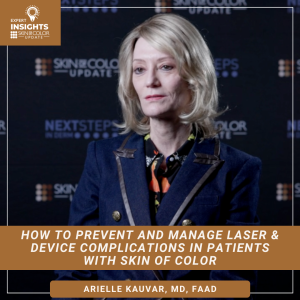
Patients with skin of color are at a greater risk of complications when treated with lasers and devices. Next Steps in Derm, in partnership with Skin of Color Update, interviewed Dr. Arielle Kauvar, clinical professor of dermatology at the NYU Grossman School of Medicine, for her pearls on preventing and managing complications. Watch as Dr. Kauvar explains the different cooling methods used to prevent pigmentary alterations due to laser and device treatment. Find out how Dr. Kauvar conducts pre-procedure exams and why she says they are important. Plus hear how taking certain steps before treatment can prevent complications.

Further Reading

If you want to read more about using lasers and devices in patients with skin of color, check out the following articles published in the Journal of Drugs in Dermatology:

A Single-Center, Open-Label, Prospective Study of a 589/1319 nm Dual Wavelength Laser for the Treatment of Facial Hyperpigmentation

ABSTRACT

Background: Facial hyperpigmentation, characterized by the excessive production of melanin in the skin, is a prevalent dermatological concern affecting individuals of various ethnic backgrounds.

Aims: To evaluate the safety and efficacy of a multi-wavelength 589/1319 nm dual-pulse duration laser device for the treatment of hyperpigmentation

Patients/Methods: A total of 17 healthy women (mean [SD] age of 43.4 [11.6] with skin phototype II-IV) were enrolled in this prospective, single-center study. Eligible participants received up to 3 treatments spaced 3 to 5 weeks apart with 2 follow-up visits at 4 and 12 weeks after the final treatment. Assessments included investigator ratings of skin quality, global aesthetic improvement, and hyperpigmentation. Safety and tolerability were monitored throughout the study.

Results: Significant improvements in hyperpigmentation and skin quality were observed at the 2 follow-up visits from baseline in most patients per investigator assessments. Patient satisfaction was high, and treatments were safe with transient self-resolving side effects such as erythema.

Conclusions: Laser treatments using a dual-wavelength 589/1319nm device significantly improve facial hyperpigmentation in patients of various skin types.

Supplement Individual Article: Algorithm for Pre-/Post-Procedure Measures in Racial/Ethnic Populations Treated With Facial Lasers, Nonenergy Devices, or Injectables

ABSTRACT

Background: Cosmetic procedures with lasers, nonenergy devices, and injectables are increasing in popularity among patients with skin of color. Published algorithms address measures to reduce side effects related to aesthetic procedures; however, none focus on reducing adverse events in skin of color.

Methods: An expert panel of dermatologists and plastic surgeons conducted face-to-face and online meetings to develop an algorithm for measures before, during, and after using aesthetic devices (energy and nonenergy-based) and injectable treatments based on the best available evidence for skin of color. Published algorithms and literature searches for aesthetic procedures provided guidance for the current algorithm. A modified Delphi method was used to reach a consensus to apply outcomes of literature searches, along with expert opinion, resulting in the current algorithm.

Results: The four sections of the algorithm outline an approach to optimize outcomes with specific before, during, and after procedure considerations. Pre-procedural consultation includes the development of a specific treatment plan based on individual patient goals and risk profile (including history and signs that may predict a higher risk for pigmentary or scarring complications). Before the procedure, sun avoidance and sunscreen use are emphasized; herpes simplex virus 1 prophylaxis and bleaching agents are administered if indicated. During the procedure, skin cleansing products are addressed, along with judicious techniques to minimize unintended cutaneous injury or inflammation. Post-procedural sunscreen and gentle skincare that may include skin-lightening agents or formulations designed to prevent infection and promote optimum healing are advised.

Conclusions: The algorithm strives to optimize treatment outcomes for patients with skin of color by providing their physicians with guidance on measures before, during, and after office-based medical aesthetic procedures.

Did you enjoy this video interview? Find more here.
Pigment-Specific Dermoscopy and AI: From the SOCU Poster Hall

By Medical Dermatology

pigment-specific dermoscopy and AI

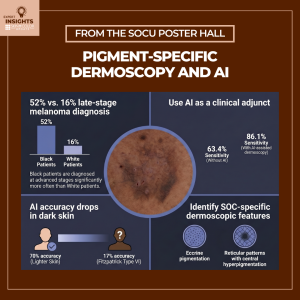
The “diagnostic gap” remains a sobering reality in dermatology. In Black patients, 52% of melanomas are diagnosed at a late stage, compared to just 16% in White patients. In addition, traditional “classic” patterns often fail dermatologists when diagnosing conditions in Fitzpatrick skin types V and VI. A poster presented at Skin of Color Update explores how to bridge this gap through pigment-specific dermoscopy and AI.

The highlights:

  • The Bias Reality Check: “Off-the-shelf” AI tools can drop from 70% accuracy in lighter skin to as low as 17% accuracy for Fitzpatrick Type VI.
  • The Power of Integration: When AI is optimized for skin of color and paired with high-quality dermoscopy, diagnostic sensitivity can jump from 63.4% to 86.1%.
  • New Clinical Pearls: Learn why you must look for skin of color-specific features like eccrine pigmentation and central hyperpigmentation to improve your diagnostic yield.

AI isn’t here to replace your clinical nuance—it’s here to be the “second opinion” that helps catch the “can’t-miss” diagnoses.

Read a Next Steps in Derm interview with lead author Zahraa Rabeeah, MD, to learn how to enhance your practice today.


Scarring Alopecias: SOCU Interview with Dr. Susan Taylor

By Medical Dermatology

scarring alopecias

Scarring alopecias require early, effective treatment to stop progression and prevent further permanent hair loss. In an interview with Next Steps in Derm, in partnership with Skin of Color Update, Susan C. Taylor, MD, FAAD, shares the latest research in the understanding of scarring alopecias and how that’s influencing the therapeutic pipeline. Dr. Taylor, the Bernett Johnson Endowed Professor of Dermatology at the University of Pennsylvania Perelman School of Medicine, outlines current and future treatments, including JAK inhibitors, metformin, and vitamin D.

For more on hair loss, join us on Saturday, June 27, for Hair and Scalp Disorders: The Rx Pad and Beyond, a virtual, one-day conference. The program provides a full-spectrum perspective on hair and scalp management, from diagnosis to therapeutics to nutrition and lifestyle factors. Led by co-chairs Adam Friedman, MD, and Amy McMichael, MD, every session emphasizes practical tools, decision-making, and real-world implementation. Register today!

Vulvar Dermatoses: From the SOCU Poster Hall

By Uncategorized

vulvar dermatoses

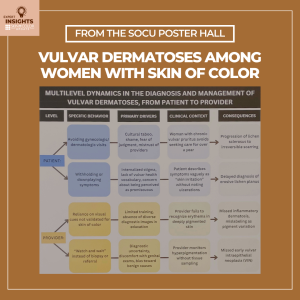
Vulvar dermatoses are often underdiagnosed in women with skin of color. Cultural stigma, structural and educational barriers, and gaps in research and clinical training all play a role in limiting care. Patients may self-manage symptoms and only seek care when the disease becomes severe. Once they seek care, they may experience gaps in clinician understanding and recognition of the severity of the disease and its quality of life impacts. These clinical barriers may lead to undertreatment.

A poster presented at Skin of Color Update examined these challenges and highlighted the need for more equitable, culturally informed approaches to vulvar dermatoses. In this Next Steps in Derm commentary, lead author Grace Herrick shares the results of a comprehensive narrative review that identified challenges and barriers to care, including the experience of shame. She also outlines a paradigm shift in how dermatology clinicians should approach vulvar health in populations that have been historically marginalized.

Psoriasis and Psoriatic Arthritis in Patients With Skin of Color

By Medical Dermatology

psoriasis and psoriatic arthritis in skin of color

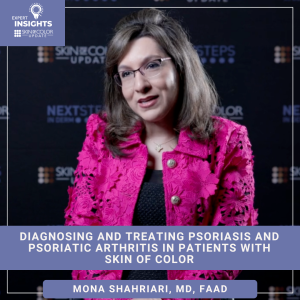
Psoriasis doesn’t look the same on every skin tone—and recognizing that matters. Dr. Mona Shahriari, associate clinical professor of dermatology at Yale University School of Medicine, encourages clinicians to broaden their psoriasis color palette to improve diagnosis and care of psoriasis and psoriatic arthritis in skin of color.

In a video interview with Next Steps in Derm, Dr. Shahriari shares:

  • Key clues for diagnosing psoriasis in skin of color
  • The clinical domains of psoriatic arthritis and how early recognition can reduce diagnostic and treatment delays
  • Research insights on scalp psoriasis
  • How pigmentary sequelae impact quality of life

This is a must-watch for clinicians committed to more equitable care of psoriasis and psoriatic arthritis in skin of color.

Be on the lookout for more video interviews with Skin of Color Update faculty that will be posted to the blog in the coming months.