
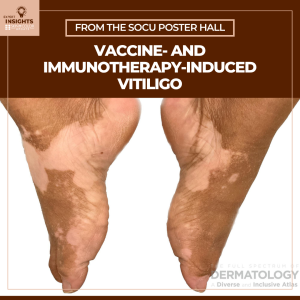
New-onset vitiligo may be a side effect of a preventative or therapeutic medical treatment, such as a vaccine or immunotherapy. When patients on immunotherapy experience vitiligo, it’s considered a positive prognostic indicator. Cancer vaccines, biologics, immune checkpoint inhibitors, and the COVID-19 vaccine can also induce vitiligo, though what this reveals about a person’s health is unknown. In patients with darker skin tones where vitiligo may be more apparent, the development of vitiligo can have unique psychosocial impacts.
A poster presented at Skin of Color Update 2025 investigates the pathogenesis of vaccine- and immunotherapy-induced vitiligo — including the impact of these conditions on patients with skin of color — and shares management strategies for dermatology clinicians. I interviewed the poster’s lead author, Sara Omari of the William Carey University College of Osteopathic Medicine.
You investigated the factors which contribute to the pathogenesis of vitiligo induced by immunotherapies and vaccines. How did you conduct your review and what did you discover?
We reviewed a variety of studies including clinical trials, case series, systematic reviews, and other studies on the topic of immune-mediated vitiligo. We found that immunotherapies enhance antigen presentation and Th1 immune responses, leading to CD8+ T-cell-mediated destruction of melanocytes.
How common is immunotherapy-induced vitiligo (IIV)?
IIV occurs in 2-16% of melanoma patients receiving immunotherapy, but the incidence varies by the particular agent examined.
IIV is a positive outcome for melanoma patients undergoing immunotherapy treatment. How is this the case?
The depigmentation effect reflects anti-melanocyte immunologic activity. Systematic reviews have shown that melanoma-associated vitiligo in particular is associated with lower disease progression and mortality. Hence, vitiligo-like depigmentation is a favorable prognostic marker in melanoma.
How long is the onset of IIV after immunotherapy treatment has started?
The onset of vitiligo will vary by immunotherapy. Vaccine-associated cases occur within 1-3 weeks, whereas biologics may induce vitiligo within one or more months after treatment.
You also looked at how IIV presents in patients with skin of color. Did you discover any research of the sort and, if so, what did you find?
In patients with darker skin tones, vitiligo is more visually apparent, more stigmatizing, and more likely to be misdiagnosed. Commonly cited misdiagnoses included tinea versicolor or post-inflammatory hypopigmentation.
How may dermatology clinicians do a better job of treating and researching IIV, especially in patients with skin of color?
Dermatologists and other providers should inquire about new-onset hypopigmentation in their patients, use a Wood’s lamp to rule out other causes, and address stigmatization and cultural norms. Further research is necessary to unveil the ways in which IIV uniquely affects patients with skin of color.
Is there anything else a dermatology clinician should know about vaccine- and immunotherapy-induced vitiligo?
Vitiligo in the setting of immunotherapy is not necessarily a sign of treatment failure. By contrast, it may be a positive prognostic indicator. Stigma reduction during treatment is especially important when treating patients with skin of color.
Additional authors of the poster include:
Sreshta Jannu, William Carey University of Osteopathic Medicine
Mashal Zaide, William Carey University of Osteopathic Medicine
Sumra Din, William Carey University of Osteopathic Medicine
Radhika Misra, Rowan-Virtua School of Osteopathic Medicine
Daniel N. Thompson, William Carey University College of Osteopathic Medicine
Stuti Prajapati, St. John’s Episcopal Hospital
